ISO/IEC 17025:2017
Accredited Calibrations
A2LA-accredited calibration to ISO/IEC 17025:2017, backed by NIST-traceable test weights and paperwork that holds up in an audit.
A scale that has not been calibrated is a guess. If you buy, sell, blend, batch, or ship by weight, that guess costs money — and if an auditor asks for proof of accuracy, "the scale seems fine" is not an answer. Calibration is how you know, and documentation is how you prove it.
Bitterman Scales operates an A2LA-accredited calibration laboratory, accredited to ISO/IEC 17025:2017 under Certificate 6010.01. Our technicians calibrate scales in the field and in the shop using NIST-traceable test weights, and every calibration comes with a report you can hand to a quality auditor, a state inspector, or a customer without apology.
We have been doing this work in central Pennsylvania since 1961. The section below walks through how a calibration actually goes, what the paperwork covers, the test weights behind it, and what accreditation and legal-for-trade requirements mean for your operation.
How a Calibration Works
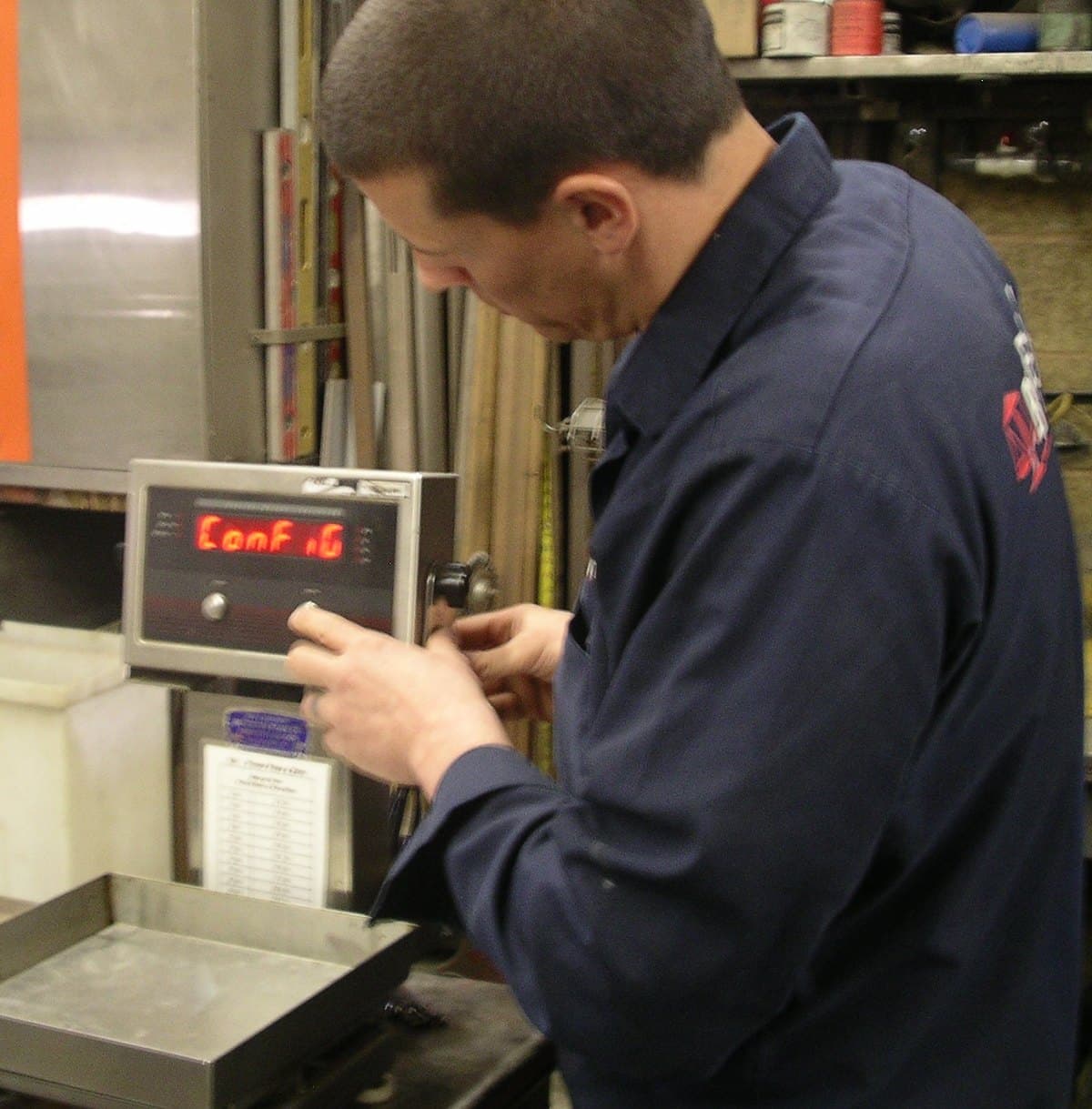
A calibration is a structured test, not a quick check. The technician starts with an as-found reading: how the scale performs before anyone touches it. That number matters. If the scale was out of tolerance, the as-found data tells you how long you may have been weighing wrong and whether product or records are affected.
From there, the technician applies certified test weights across the scale's range and at the corners or sections of the platform, checks linearity and repeatability, adjusts the scale if it is out, and records the as-left readings. You get both sets of numbers on the report. If we find a mechanical or electronic problem during the test — a bad load cell, a damaged check rod, debris under the platform — we tell you before we adjust around it.
- As-found readings recorded before any adjustment
- Test loads applied across the range and at platform corners or sections
- Linearity, repeatability, and shift tests as the scale type requires
- Adjustment to tolerance, then as-left readings recorded
- On-site service throughout central Pennsylvania and northern Maryland, or in our Lancaster shop
A scale that has not been calibrated is a guess.

Documentation That Passes an Audit
Every calibration we perform is documented. The calibration report identifies the scale by make, model, serial number, and location, lists the test weights used and their traceability, and shows as-found and as-left readings against the applied tolerance. Accredited calibrations issued under our ISO/IEC 17025:2017 scope also carry the A2LA symbol and reported measurement uncertainty.
If your quality system runs on ISO 9001, GMP, HACCP, or a customer-imposed standard, these records slot straight into it. We can issue certification letters where a summary document is needed, and we keep calibration history on file, so when an auditor asks for last year's records — or the year before — you can produce them. Many customers put their scales on a scheduled calibration interval with us so the records never lapse.
- Calibration reports with as-found and as-left data
- Test weight identification and NIST traceability on every report
- Accredited certificates with measurement uncertainty under A2LA scope
- Certification letters for quality-system files
- Calibration history retained and retrievable for audits
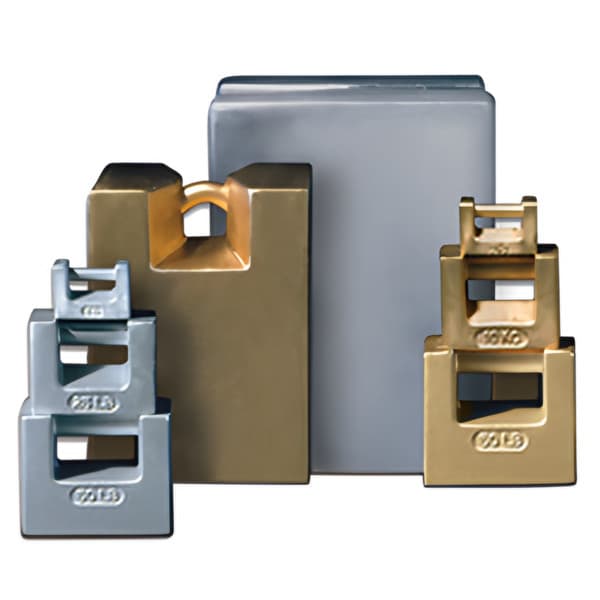
Test Weights and Weight Classes
Our field standards are NIST-traceable test weights, maintained and recertified on schedule. For truck scales, floor scales, and other industrial scales, we use Class F cast iron weights — the workhorse standard defined in NIST Handbook 105-1 for testing commercial and industrial weighing devices. For balances and precision scales, we use stainless steel weight kits built to ASTM E617 tolerances.
Weight classes are just tolerance grades. ASTM Class 1 is tight enough to calibrate analytical balances reading to a tenth of a milligram. Classes 2 through 4 cover precision toploaders and bench scales. NIST Class F covers industrial work, where the tolerances are wider because the scales are too. The rule is simple: the standard must be meaningfully more accurate than the scale it tests. We match the weight class to your equipment, and we also sell certified weights and kits if you want to run routine checks between our visits.
- NIST Class F cast iron weights for industrial and vehicle scales (Handbook 105-1)
- ASTM E617 Class 1 stainless steel weights for analytical balances
- ASTM Class 2-4 kits for precision and bench scales
- Weight recertification available for customer-owned test weights
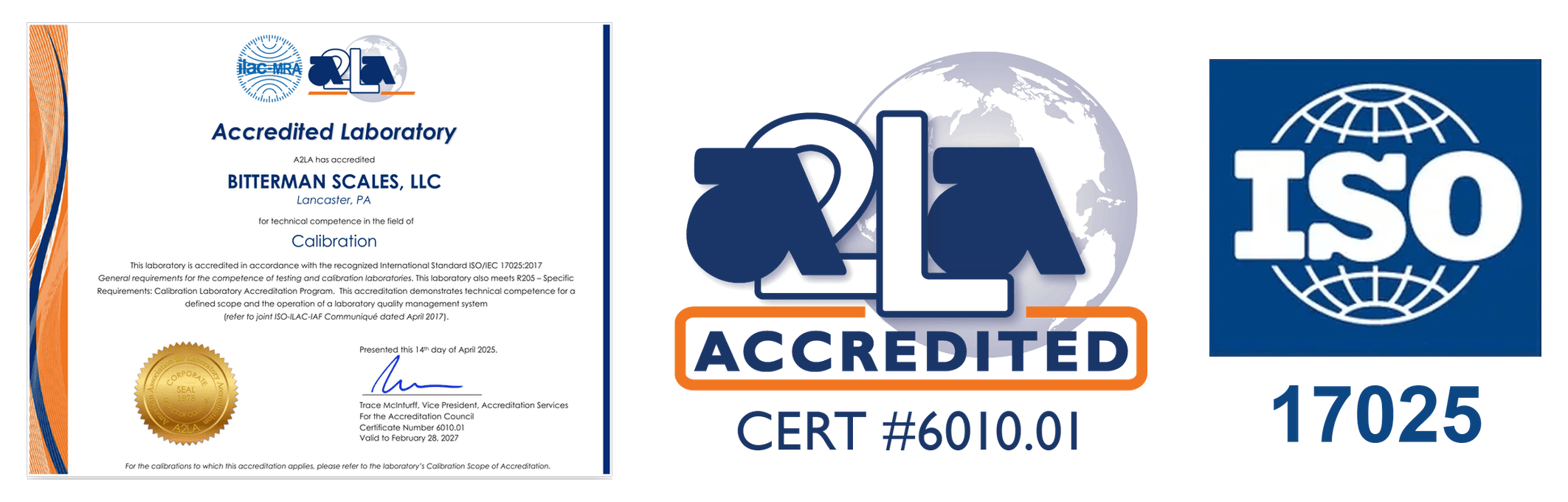
A2LA Accreditation to ISO/IEC 17025:2017
Bitterman Scales is accredited by A2LA (the American Association for Laboratory Accreditation) to ISO/IEC 17025:2017, the international standard for the competence of testing and calibration laboratories, under Certificate 6010.01. Accreditation means a third party has assessed our procedures, our technician training, our measurement uncertainty calculations, and our standards — and re-assesses them on a recurring cycle.
Here is the practical difference. A traceable-only calibration says the test weights trace back to NIST. An accredited calibration says that, plus: the lab's methods were independently audited, the certificate reports measurement uncertainty, and the work falls under a published scope of accreditation you can look up. Some auditors and customers accept traceable-only certificates. More of them every year require accredited ones, because ISO 9001 registrars and large customers lean on ILAC-recognized accreditation as their proof of competence. If your auditor has ever pushed back on a calibration certificate, this is usually why. Tell us what your quality system requires and we will issue the right certificate the first time.
- Accredited to ISO/IEC 17025:2017 by A2LA, Certificate 6010.01
- Accredited certificates include measurement uncertainty
- Published scope of accreditation, independently assessed
- Traceable-only calibration still available where accreditation is not required
Common questions
How often should my scale be calibrated?
It depends on how the scale is used and what your quality system requires. Legal-for-trade scales must at minimum pass state inspection, and most commercial and quality-critical scales are calibrated every six to twelve months. Heavy use, harsh environments, or tight process tolerances call for shorter intervals. We can recommend an interval based on your equipment and put you on a schedule.
What is the difference between an accredited calibration and a NIST-traceable calibration?
A traceable calibration means the test weights trace back to NIST standards. An accredited calibration adds independent proof of the lab's competence: our methods and uncertainty calculations are audited by A2LA against ISO/IEC 17025:2017, and the certificate reports measurement uncertainty. Many auditors and large customers now require the accredited version. If you are not sure which you need, check your quality manual or ask your auditor — or ask us.
What does NTEP approved mean, and do I need it?
NTEP approval means a scale model passed evaluation under the National Type Evaluation Program and holds a Certificate of Conformance. You need it if the scale is used to buy or sell by weight, because state weights and measures law requires commercial devices to be NTEP approved and to meet NIST Handbook 44 tolerances. Scales used only for internal checks do not need NTEP approval.
Do you calibrate scales on site?
Yes. Most industrial calibration is done at your facility — a truck scale obviously can't come to us. Floor scales, bench scales, and balances can be calibrated on site or in our Lancaster shop, whichever fits your operation. Our trucks carry NIST-traceable certified test weights, and we serve central Pennsylvania and northern Maryland.